

HtAG Analytics Launches Free Map of 8,000+ Australian Infrastructure Projects for Buyer's Agents and Investors
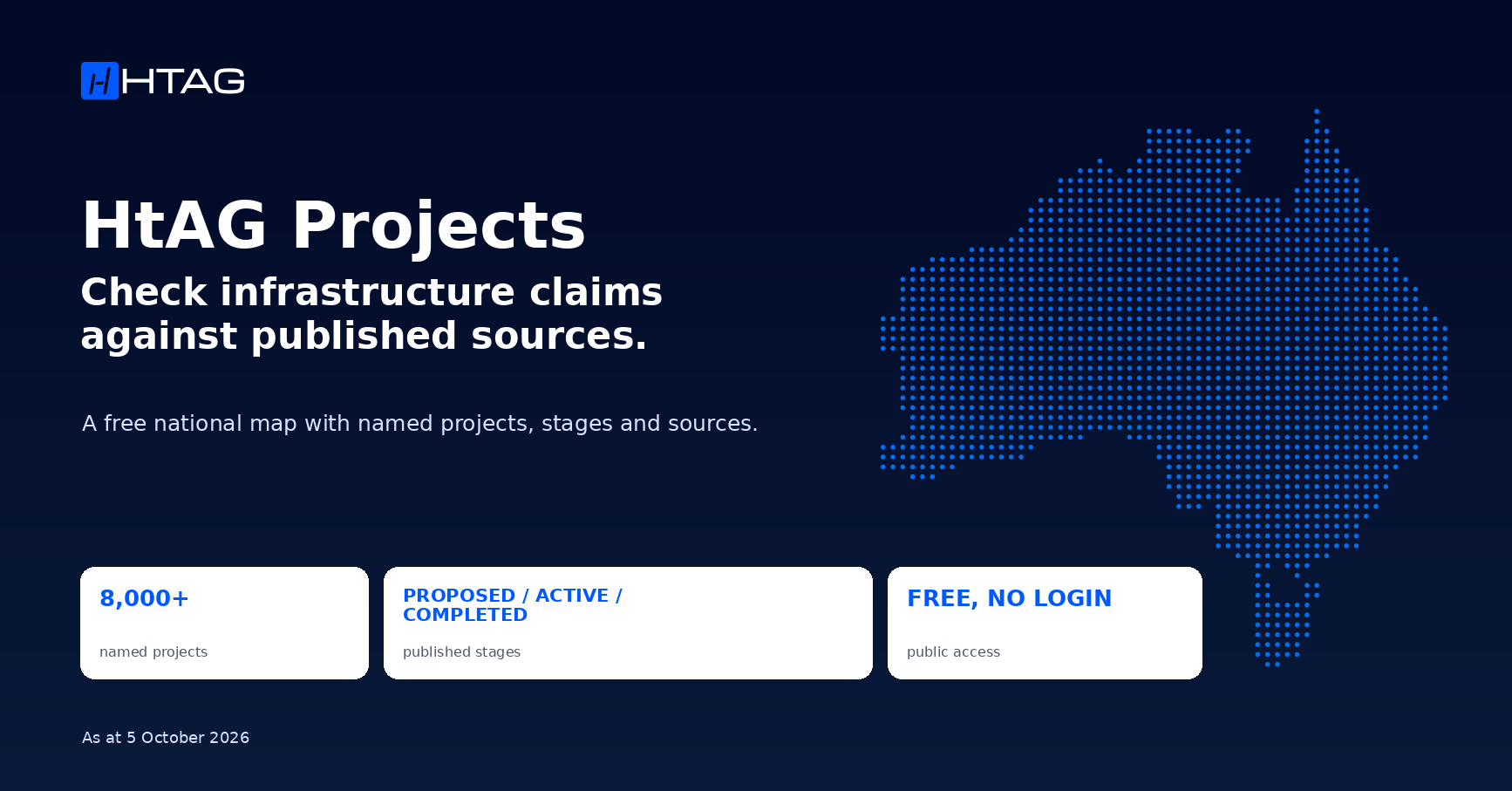
HtAG Projects maps 8,000+ named Australian infrastructure projects across proposed, active and completed work. The free map requires no login; figures shown are as at 5 October 2026.
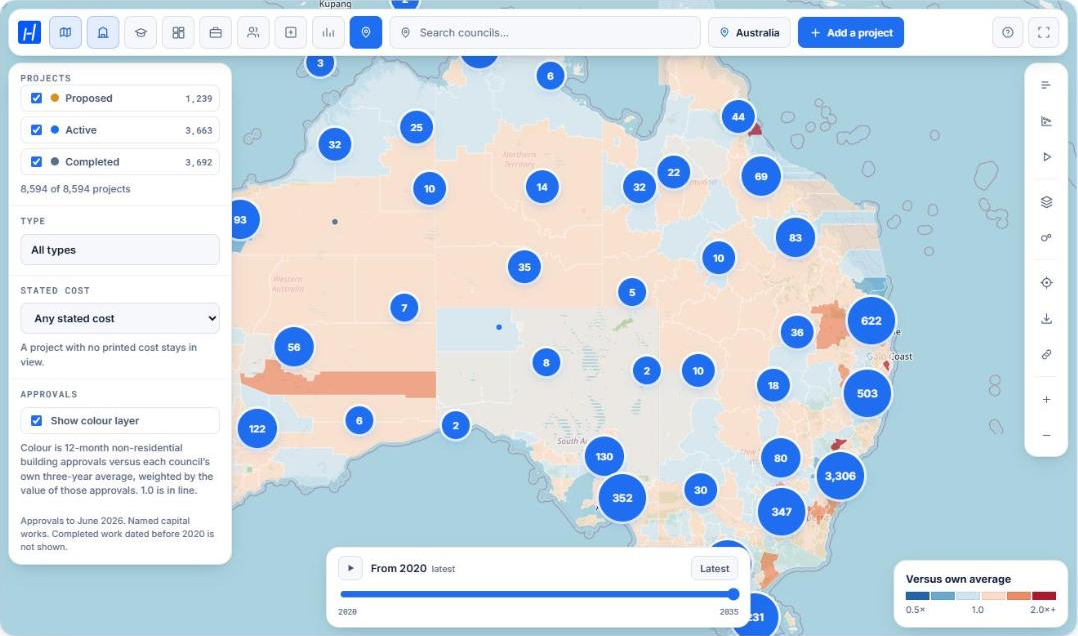
HtAG Projects infrastructure map, as at 5 October 2026. The live map separates named project pins from council-level building-approval colours.

HtAG Projects helps buyer's agents and investors see named works, read the published evidence and take sourced material into a client report or further due diligence.
HtAG Projects helps buyer's agents and investors verify 8,000+ Australian infrastructure projects with named sources, stages and client-ready exports.
HtAG Analytics has launched HtAG Projects to close that gap: a free national research map listing 8,000+ named public and private infrastructure projects across Australia as at 5 October 2026.
In practice, HtAG Projects moves a buyer's agent or investor from a promotional claim to a named project with a published stage, stated cost, timing and source, ready for due diligence or a client report, without treating infrastructure as a guarantee of property growth.
What is HtAG Projects?
HtAG Projects is a free, no-login map built to shorten the time between hearing an infrastructure claim and checking the published evidence behind it. Users can search by project, place or council, open an individual project, or open a written brief for a whole council.
As at 5 October 2026, the map's live counter shows 8,594 named projects: 1,239 proposed, 3,663 active and 3,692 completed. Published stated costs run from local upgrades to multi-billion-dollar programs. Completed work dated before 2020 is not shown.
New users can follow the step-by-step research guide, which takes a project from the map to a source check and a one-page brief.
Why infrastructure claims are hard to check
The difficulty is rarely a lack of information; it is scattered sources and loose language. "Coming soon" can describe a project that has only been announced. HtAG Projects uses three published stages so the difference stays visible: proposed means announced or in planning; active means approved, awarded or under construction; completed means delivered. These categories help stop an announcement being described as if construction had started. Users should still open the named source, because dates, costs and status can change.
How buyer's agents can use it
A buyer's agent can use HtAG Projects before making or defending a client recommendation:
• Search the suburb, place or council and separate proposed, active and completed work.
• Open the relevant projects and check the name, published stage, timing, stated cost and source.
• Copy a source-ready citation into the client report so the evidence can be checked.
• Export the council view as an A4 brief, CSV or PNG, or copy the written briefing as text.
The value is faster verification and a clearer evidence trail. A recommendation can separate a plan from work under way and show the client exactly where the evidence came from.
How investors can use it
An investor can use the map to test a claim made in a listing, a conversation or a suburb summary. If someone says a rail link, hospital or industrial project is "coming", the next questions are whether it is announced, approved, awarded or under construction, who is delivering it, and which source supports the description.
The map does not show that a project will cause price or rent growth or any particular investment outcome. It gives the investor a sourced starting point for independent checks, and for professional advice where needed.
A worked example: Western Downs
The public Western Downs brief at https://www.htag.com.au/projects/qld/western-downs/ shows 42 named projects as at 5 October 2026: 7 proposed, 10 active and 25 completed. It shows $44.1 billion in stated costs across the 30 projects with a published value.
The brief also lists active energy, transport, community and water work, and proposed energy and industrial work. Each project can be opened individually, so a statement made to a client rests on named records and sources rather than the council total.
What the council colours measure
A pin is one named capital project. A council colour compares the latest 12 months of non-residential building approvals with that council's own three-year average, weighted by the value of those approvals.
A reading of 1.0 is in line with the council's own recent history; below 1.0 is quieter and above 1.0 is busier. The comparison is against the council's own history, not its neighbours, and it is not a property-price forecast. Price, rent and yield data for the same councils is available separately at https://www.htag.com.au/lga-suburb-heatmap/.
Where the project data comes from
HtAG Projects compiles named works from the bodies that build them and the registers that record them, including transport, school and health agencies, energy and water utilities, national and state infrastructure pipelines, Defence, major-project lists and council development applications. Stated values are the costs published for each project, not HtAG estimates.
The map is in beta and coverage is uneven between councils, so it is a starting point rather than a complete register. Every council's public brief is listed at https://www.htag.com.au/projects/.
How to access HtAG data in AI tools
Developers and teams building research workflows can access HtAG data through the Developer Portal at https://developer.htagai.com/, which provides API and MCP access for approved applications and AI tools.
Explore the free map
About HtAG Analytics
HtAG Analytics is an Australian property intelligence company. Its research platform covers 7,000+ suburbs with 150+ metrics, and its data is available to AI agents through 70+ public MCP tools across 6 MCP servers. HtAG builds tools that help property professionals and investors inspect evidence and separate published observations from unsupported claims.
Source note
Figures describing HtAG Projects are observations from the live product page and the Western Downs public brief as at 5 October 2026. Project stages, costs and timing can change; check the source attached to each project before relying on it. HtAG Projects provides research information, not personal financial, credit, legal or property-investment advice.
Dr Matija Djolic
HtAG Marketing
admin@htag.com.au
+61 2 5563 4415
Visit us on social media:
LinkedIn
Instagram
Facebook
YouTube
TikTok
X
Legal Disclaimer:
EIN Presswire provides this news content "as is" without warranty of any kind. We do not accept any responsibility or liability for the accuracy, content, images, videos, licenses, completeness, legality, or reliability of the information contained in this article. If you have any complaints or copyright issues related to this article, kindly contact the author above.
