

Finding Belonging Through Project-Based Learning: Inside the Sheepscot Team at Mt. Ararat Middle School
Sheepscot students created this poster. Teacher John Hawley shared, ‘This says it all. I know there’s only one T in Sheepscot, but the sign was too perfect, and I didn’t have the heart to tell the kids they spelled it wrong.
At Mt. Ararat Middle School in MSAD 75, mornings in the Sheepscot Alternative Education Program begin not with a bell or worksheet but with music. On “Jazzy Tuesdays,” as students enter the classroom, the sounds of Herbie Hancock’s piano drift throughout the room, along with genuine and boisterous welcomes from alternative education teacher John Hawley and educational technician Huey Sheffler. As students find their seats, they settle into a “moment of chill” before the day begins.
“That time is intentional,” Hawley said. “We’re asking students to be fully present, so we create space for them to arrive, reset, and feel grounded before the day begins.”
A Different Approach to Learning
The Sheepscot Team has been redesigned from a small population in an all-day, secluded model to a thriving, project-based learning alternative education environment. Today, it serves 32 seventh- and eighth-grade students—about 16 students per grade—with a focus on relationships, project-based learning, and social-emotional learning.
Each day follows a consistent but flexible structure. After the morning’s “moment of chill,” students and staff head outside for their daily pond loop walk, regardless of the weather. The walk takes about five minutes and allows students to ground themselves in nature and connect with their classmates and teachers in a non-scripted manner.
“We go outside every day, no matter what,” Hawley said. “It’s part of who we are. Movement and fresh air help students regulate and get ready to learn.”
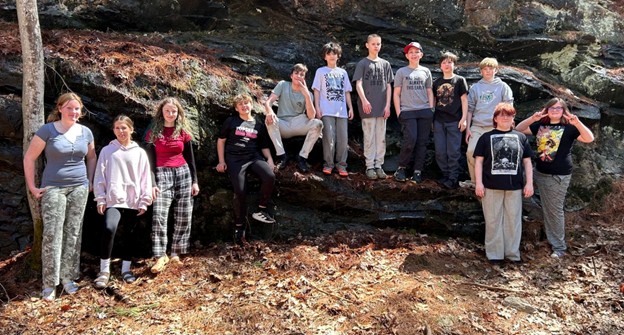
Sheepscot students on a pond loop walk following a fresh snow
Back in the classroom, students watch CNN 10 and generate questions about current events, which later fuel weekly review games and discussions.
From there, the day shifts into the heart of the program: project-based learning.
Learning That Feels Real
In Sheepscot, projects are not an add-on; they are the foundation of learning. Students explore rigorous academic projects through immersive, hands-on experiences that connect to real-world systems. Eighth graders are currently engaged in the “World Game,” where they design countries, manage resources, and navigate global relationships.
“You learn everything here, just in a different way,” one student shared. “It actually makes sense because you’re doing it. I feel smart in here.”
The seventh graders are currently working on a “Shark Tank”-style challenge to develop solutions to reduce plastic waste and address climate impacts. Each group approaches the problem differently, highlighting creativity, student voice, and healthy debate among students.
Other projects have included building skateboards to demonstrate Newton’s Laws of Motion and designing interdisciplinary units based on student interest, such as an exploration of ancient Pompeii.
Sheepscot students designing and building skateboards
“We give students choice through project menus,” Sheffler explained. “That ownership is what drives investment.”
An example of a project menu exploring the amendments to the US Constitution
Building Skills for Life
Beyond academics, the program integrates real-world skills into daily learning. Students participate in systems that simulate adult responsibilities, including personal finance and economic decision-making.
They earn paychecks based on attendance, work habits, and grades, allowing students to earn raises based on these behaviors. Students also learn about the stock market with investment profiles, credit scores, and stock market simulations. Students will soon experience a “bank run” that will wipe out their hard-earned savings.
A sample paycheck and Sheepscot students in line to deposit their weekly paychecks
“They feel the impact of their decisions, and that sticks with them,” Sheffler said.
Hawley and Sheffler intentionally include members of their school community in their learning. The Mt. Ararat Middle School office staff are invested members in the personal finance unit and have stock profiles. This approach teaches students that what they are learning in Sheepscot goes beyond their classroom walls.
Student Voice and Civic Engagement
Sheepscot students also engage deeply with civics and democratic processes. Through mock trials, elections, and student-led discussions, students explore topics like the presidency and Supreme Court.
In one activity, Sheepscot students simulated the three branches of the U.S. government. They elected a president who wanted the class to bake apple pies. The rest of the team served as a divided legislature trying to pass a bill for either blueberry or cherry pie. Three students were confirmed by the legislature to serve on the Supreme Court to uphold the rules of the process. By using structured argument and legislative-style processes, the bill for blueberry pie was vetoed, and the team enjoyed baking and eating apple pie.
“It sounds simple, but they’re learning how to think, debate, and listen,” Sheffler noted. “Those are lifelong skills.”
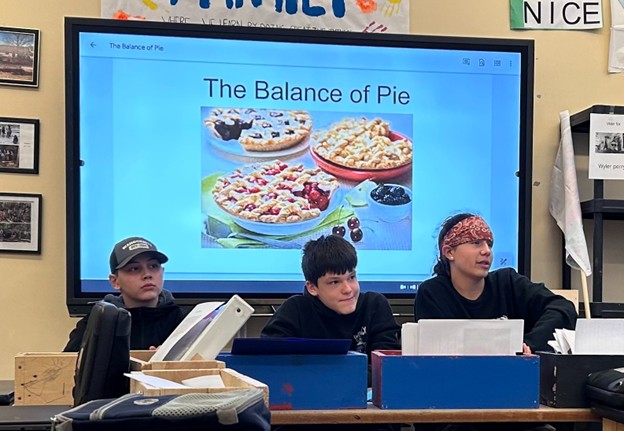
Sheepscot students participating in a mock Supreme Court confirmation hearing
Pathways Into the Sheepscot Team
Enrollment in the Sheepscot Team is intentional and collaborative, with a clear, structured process. First, sixth-grade teachers recommend students for the Sheepscot Team. Next, the principal and counseling team review these recommendations with Hawley and Sheffler. They prioritize students based on need, school engagement, and overall fit for the program. They also work to ensure students will be positive and productive contributors.
Selected students then become candidates. Hawley contacts families to explain the program to them and obtain permission to move forward with the process. This step helps to establish an early foundation for positive relationships. Hawley and Sheffler then interview candidates to assess readiness for a project-based model of teaching and learning. Finally, candidates participate in a “Sheepscot experience.” This allows both staff and students to reflect on whether the program is the right fit for seventh grade.
“This only works if students want to be here,” Hawley emphasized. “It’s an opportunity, not a placement.”
Accepted students receive a “golden ticket” invitation. Hawley and Sheffler say they want students to know that it is a privilege to be part of this community.
An important piece to the enrollment process is how the Sheepscot Team begins building connections with prospective students early. All sixth graders participate in rotating five-week enrichment blocks that occur throughout the school year, introducing students to project-based learning and the program’s routines. Students work in teams and build team identities by creating team names, mottos, and handshakes. Then, they take on various challenges.
These enrichment blocks strengthen the Sheepscot Team’s connection with the school by including all students. They also allow Hawley and Sheffler to start to build relationships with future Sheepscot Team students, ensuring that the students entering the program are a good fit.
Connected to Community
While the program offers a distinct learning environment, it is not isolated. Students participate in mainstream classes and school activities, and staff across the school community engage with Sheepscot projects.
Families stay connected through regular updates and project sharing, and a new alumni initiative invites former students back to mentor and support current participants.
“We’re not an island,” Sheffler said. “This is part of a larger community that believes in these kids.”
A Model That’s Working
With a growing waitlist and strong student outcomes, the Sheepscot Team stands as a powerful example of what’s possible when education is designed around relationships, relevance, and student voice. Students, staff, and families all have stories of transformation, new friendships, and moments when a student who once dreaded school suddenly can’t wait to show up.
“There’s a sense of joy here,” Hawley reflected. “Students feel like they belong, and that makes all the difference.”
As Maine schools continue to explore innovative approaches to learning, programs like Sheepscot offer a compelling reminder: When students are engaged, supported, and seen, they thrive.
Related
Legal Disclaimer:
EIN Presswire provides this news content "as is" without warranty of any kind. We do not accept any responsibility or liability for the accuracy, content, images, videos, licenses, completeness, legality, or reliability of the information contained in this article. If you have any complaints or copyright issues related to this article, kindly contact the author above.
